
CATHEDRAL QUEST
Our quest to experience the great cathedrals and churches of Europe




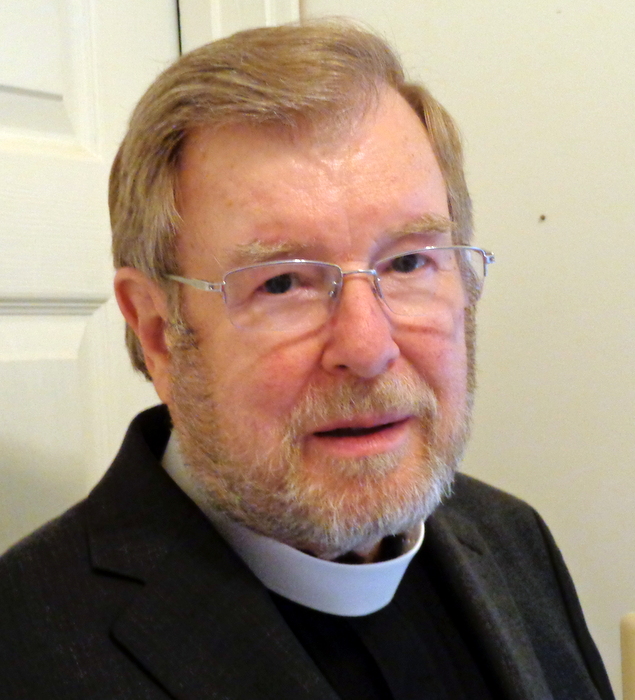
My name is
Thomas Davies Clay.
I was born in
Huntington, West Virginia in 1938 and grew up in Ashland, Kentucky - 17 miles
from Huntington. I received a B.A. from Marshall University in
1960 and a M.Div. from the Episcopal Theological Seminary in Lexington, Kentucky
in 1963.
I was ordained an Episcopal
priest on December 1, 1963.
For
the next 35 years I served parishes in Richmond, Kentucky; Washington, North
Carolina; LaGrange, Georgia; Front Royal, Virginia; and California, Maryland.
I retired from active parish ministry in 1998 at age 60.
Since retirement I have been an interim rector of two parishes in
Southern Maryland plus I continue to take Sunday services in area churches when
needed. I am also Parish Associate at St. Paul's Church in
Alexandria, Virginia.In 2000 we built our retirement home in Maryland, fifteen miles south of
Washington, D.C.
A
64 YEAR INTEREST IN CATHEDRALS
Washington National
Cathedral
One of my favorite
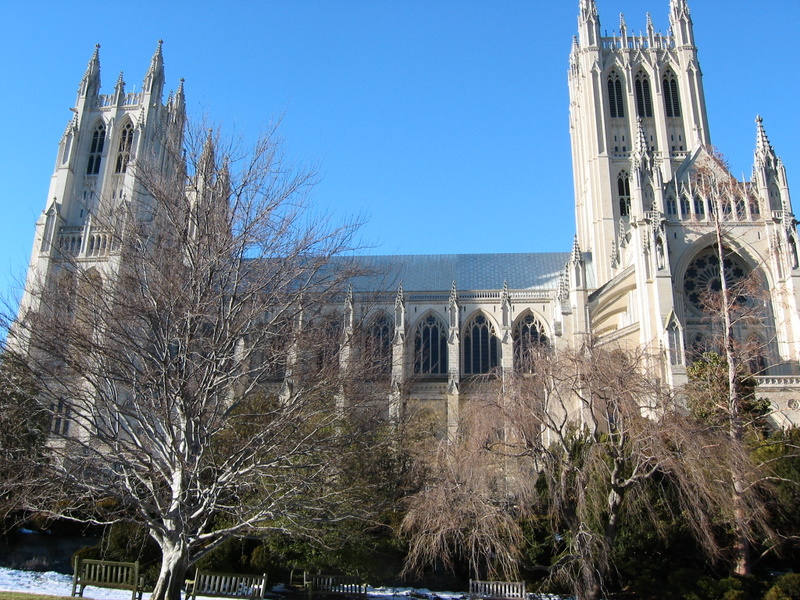
memories is that of my first visit to the Washington National Cathedral in 1953.
I was fifteen, and my Great Uncle Oley took me on a C.
& O. railroad Cherry Blossom excursion to Washington from Huntington.
Great Uncle Oley, who never married, was like a grandfather to me.
Both of my grandfathers died the year before I was born.
We rode all night on the train, toured all of Washington including the
Washington Cathedral and Mount Vernon and came home that night.
I was awed by the
Washington Cathedral which by that time had been in progress for forty-six years
with thirty-seven years more before its final completion.
Very little of the nave had been completed at that time.
During my college days, I made several trips to D.C. always with a visit
to the cathedral to see the progress. The
years from 1951 to 1986 saw great strides in the construction led by The Very Rev.
Francis Sayre Jr, who had become the new Dean.
I remember on one of my college trips sitting in the great choir on
Sunday as the Great Litany was sung in procession.
The choir left the chancel and processed around the interior of the
church
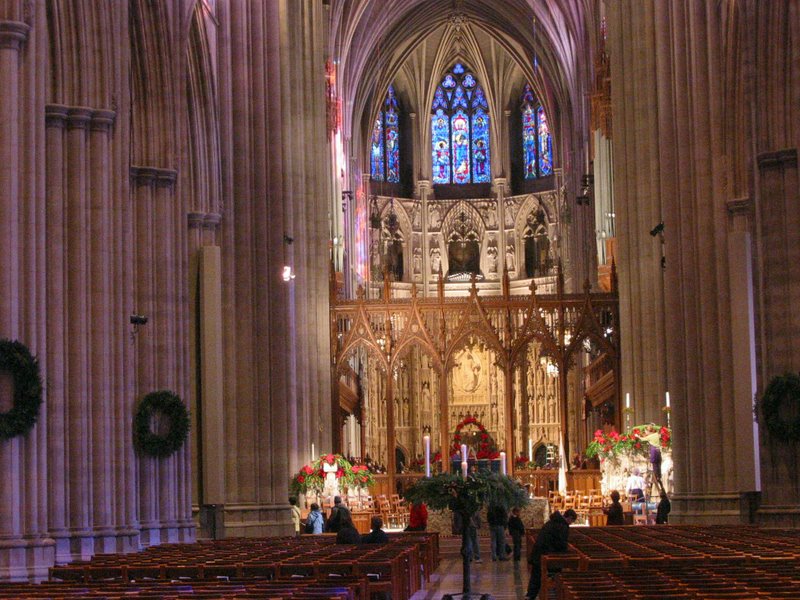
and back to the choir. I recall that the nave was
completed only to the second bay with a tall wooden wall at the west end.
After I was ordained,
I was fortunate to attend the College of Preacher on three occasions, traveling
from either Kentucky, North Carolina and Georgia. The
College of Preachers, now called the Cathedral College, is located directly
behind the cathedral. These weeklong
sessions gave me ample opportunity to explore the cathedral during free times.
It was always thrilling to see the progress.
In 1978, I became Rector of Calvary Church, Front Royal, Virginia which is 65 miles
from the cathedral. Many events of
the Diocese of Virginia were held at the Washington Cathedral, which again was a
time to renew my enthusiasm for this great building.
It was completed in 1990, but unfortunately I was not able to attend the
dedication. In 1994 I became
Rector of St. Andrew’s, near Leonardtown, Maryland.
It was the same distance to the cathedral as from Front Royal.
I was now in the Diocese of Washington.
All the events of the Diocese were held at the cathedral.
So for over fifty years, the Washington National Cathedral has been an
extremely important part of my life.
SEE MY MINI
MODEL
FIVE
WONDER FILLED YEARS AS A DOCENT
 I
I
n 2002, I read an announcement in the
Diocesan newsletter that the cathedral was looking for volunteers to
be docents (teaching tour guides). I thought that this would be a
wonderful opportunity to really enjoy this inspiring building. At
this point, I was retired and only lived twenty-five miles away. I
took the three month course of instruction about every facet of the
cathedral. There was a tremendous amount of learning – architecture,
history, stained glass windows, various chapels, stone and wood
carvings. We were tested and had to give several trial tours which
were critiqued by the cathedral staff. The first time giving a tour
to 50 eighth graders was even more frightening!
It was a fun and
rewarding experience giving 30 minute, and sometimes longer, tours
three or four times each Wednesday. During the school year we
would often be visited by 25 or more student groups a day from all
over the United States plus many adult tour groups as well as
walk-in visitors. School groups were always a challenge! It
would take a lifetime to see, learn and understand all of the
architecture and the art of the Washington Cathedral.
Being a
docent was exciting not only being able to share the wonder of the
cathedral with visitors, but being able to see and learn or in the
case of us senior folks relearning, something new every time we
stepped into the wonderment. I remember Malcom Miller, who has been
giving tours at Chartres Cathedral since 1958, saying to us on his
wonderful tour of Chartres that he learned something new about
Chartres Cathedral every time he gave a tour. All cathedrals tell
wonderful stories in their architecture and art work. That was one
of the reasons for so much stained glass, paintings and sculpture in
churches. When many of the medieval cathedrals were built people
couldn’t read and there were not many books, if any available, so
they could “read” a stained glass window, a painting or sculpture
and learn a Bible story or about the life of some saint or historic
event. The Washington Cathedral is noted for its beautiful wood
carving. Because of my interest in woodworking I was asked to give
special tours on the wood carvings .
BEGINNING
OUR CATHEDRAL QUEST
Being a docent at the beautiful Gothic
Washington Cathedral whetted my appetite to see the great cathedrals of Europe.
my wife, before we were
married, had traveled often in Europe for pleasure and business. She
had encouraged me for several years to travel abroad, but I was
insecure about flying over the ocean. One day after spending the day
at Washington Cathedral, I came home and announced that I would like
to go to England and visit cathedrals. I think she had plane
reservations several hours after that announcement.
Thus in the spring of 2003 we began
our “CATHEDRAL QUEST”.
So
far my wife and I have, in the past 14 years, have spent 192 days in Europe
and visited 274 Romanesque, Gothic, Renaissance, Baroque and Moorish cathedrals, abbeys, churches
plus
a number of castles and museums in 119 cities in 11 countries.
For each "CATHEDRAL QUEST" trip we spent many months
planning before departure, deciding on the churches we wish to visit, booking
hotels and restaurants, and travel routes.
We
read architecture and history books about the churches we want to explore as well as
other places of interest in each city.
My
wife is the expert on hotels, restaurants, art museums, and shopping, and makes many advanced reservations.
On all of our CATHEDRAL QUESTS, we have kept a very
detailed daily journal. for the past five
years, I have carried a small laptop on which I record the daily
activities and email them each day, along with several photos, to
our families. For the last several years I have taken advantage of
Dragon software which allows me to dictate these journals.I have taken
thousands of photographs which we identified by file number each day in our
journal. except for filling in a few
details and some history the daily information on my computer is
ready for this website. I am afraid that Cathedralquest.com not yet
up to date. The software that I use for a number of years was phased
out two years ago,and I have had to learn a whole new system, which
at my age has been most difficult. I hope to have this webpage up to
date in the near future. You are invited to come back from time to
time to see my latest additions.
CATHEDRAL MODELS
Several years ago, I discovered cathedral
model kits and began making models of the cathedrals we wanted to explore.
Please look at these model pages. I
have made over 50 models of cathedrals, abbeys, castles and other historic
buildings. I have kits to build 65 more (if I live that long :-))
The
models that I have made, are very detailed and take hours upon hours to make.
Many parts are so small, I had to use tweezers. Spending so much time
with these models increased my anticipation of seeing them in person and
examining details that the casual observer might miss. Please
visit all my
cathedral models.
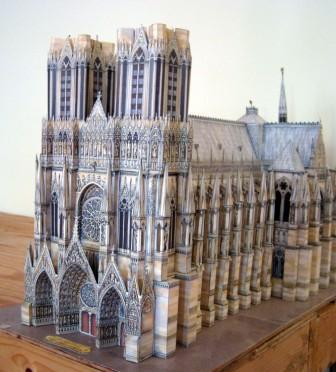
This
model is Reims Cathedral in France.
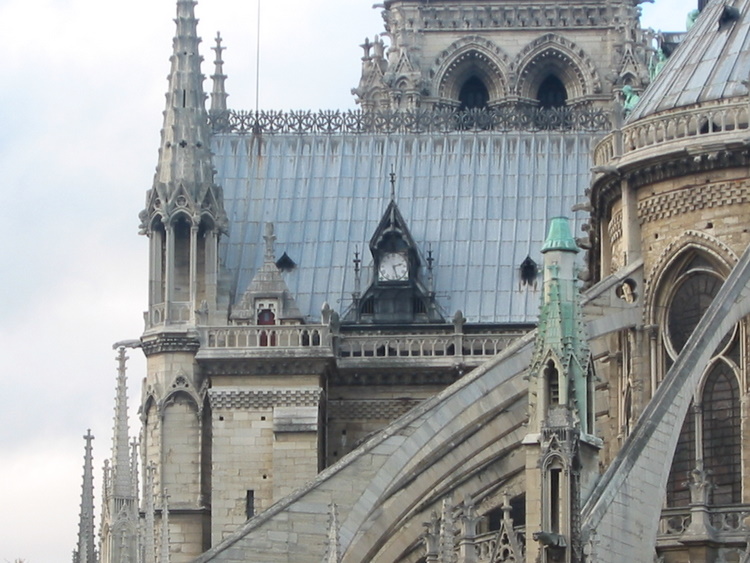
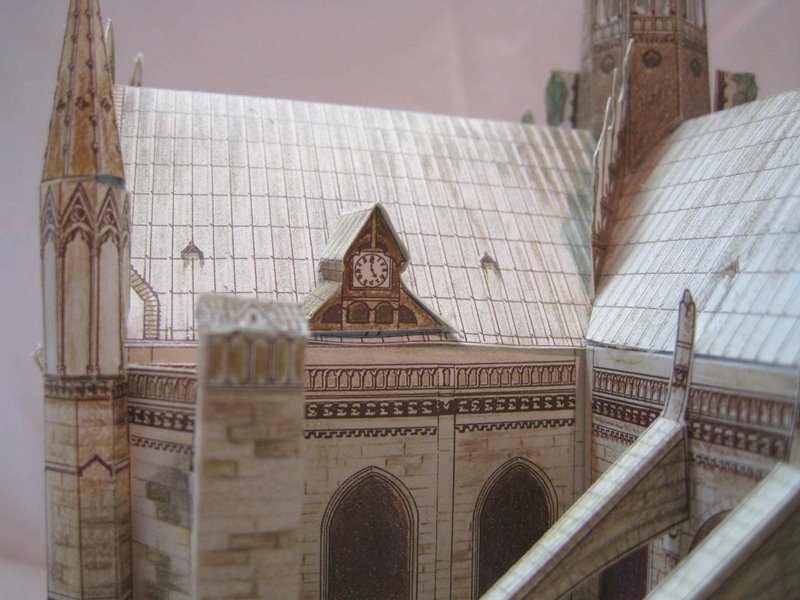
For example, we visited Notre Dame in Paris before I made the model.
When I assembled the clocks on both sides of
the transept roofs,
I did not
remember seeing these little clocks when we were there.
When we made a return trip to Paris in 2006, I had to check them out and sure enough they were really there. I had taken
pictures of the model with me.
I
then took a number of pictures of the real clocks – just for proof.
SHARING
OUR CATHEDRAL QUEST IN LIFETIME LEARNING PROGRAMS
After returning from France in 2005, I
was leading the Wood Carving tour at the Washington Cathedral for a Lifetime
Learning Class at Northern Virginia Community College.
Several members of the class asked if I would come to the college and tell
them about my trips.
This has lead
to teaching an eight week class at Lifetime Learning Institutes at George Mason
University, Northern Virginia Community College and the College of Southern
Maryland.
I
entitled my class “From Solomon to
Gaudi: A History of
European Church Architecture”.
The
use of the cathedral models, mentioned above, in teaching these classes has been received with great enthusiasm. When presenting the slides of the
cathedrals on the screen, I can lift up and point out the exact locations
on the models. Since the models are to scale, it is enlightening to
compare one or more cathedral models during a lecture.
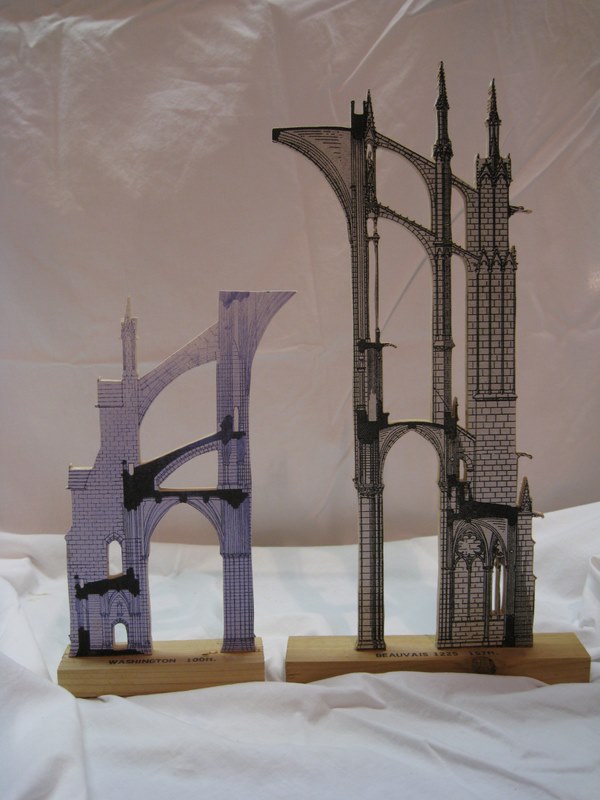
A
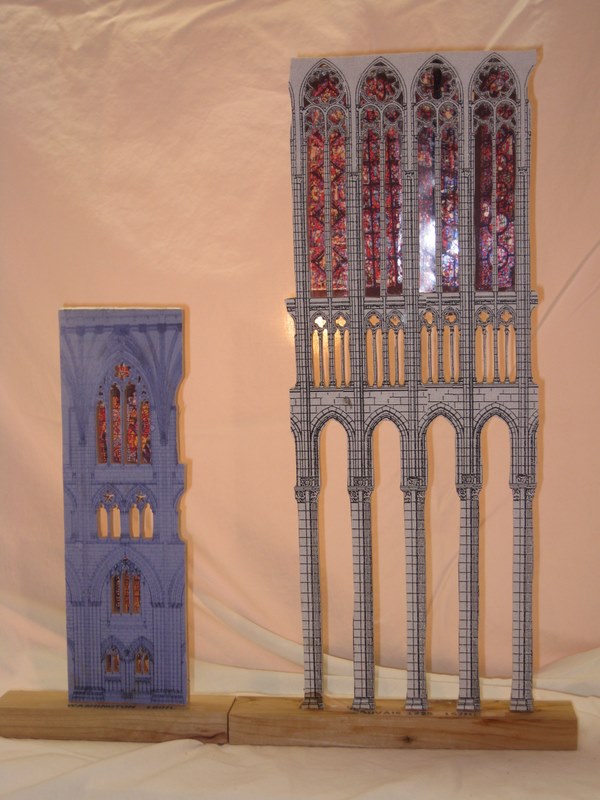
second visual aid that I have found extremely helpful is the use of models of
elevations and buttresses. I photocopied the elevations and buttresses of
nine cathedrals which were created by Alberto Berengo Gardin and are
included in Gunther Binding's book - High Gothic. I enlarge
these drawings until they reached the size of 1 inch to 10 foot scale.
Then I glued them to 3/4 inch plywood and cut them out on my scroll saw. I
printed, on acetate, the actual windows from each of these cathedrals and
then mounted them in the window opening on the elevations. I was able to
photograph the elevation and buttress drawings of the Washington Cathedral and
mounted them to use as a comparison since most of those taking my lectures have
been in the Washington Cathedral. I use these comparisons so my students
get a sense of the various heights and side elevations.
Here is an example of comparing the Washington Cathedral - on the left- with
Beauvais in France- on the right. The interior height of Washington
Cathedral is 100 ft ( the model is 10 inches). The height of Beauvais, which is
the tallest cathedral in the world, is 157 ft (the model is 15 1/2 inches).
THE
GOALS OF THIS WEB SITE
In the spring of 2009, I took a class on
travel writing at the Smithsonian Institution.
The lecturer,
Michael Luongo, who
has written a
number of travel books, encouraged me to write a book about our cathedral
adventures and to include the material that I use in my cathedral lectures.
He further suggested that I might start by creating it on a website. having
created my website for my woodworking – creations – by – Thomas.com, I had some
knowledge of how to create webpages so I decided to take Michael's advice and
thus
CATHEDRALQUEST. COM was born.
Unfortunately, almost 3years ago the software that I had been using for the
past 11 years was phased out. The replacement software has been very difficult
to master. I have had to relearn the process which has consumed a
tremendous amount of time and energy for my old brain.
The reformatted and partially updated
website was reposted on June 12, 2015. I still have several years
to add to this webpage.
I have been extremely pleased with the response to this webpage. it
receives between 700 and 800 a day. I have made friends all over the
world. I have had the privilege of visiting some of them in the past
several years plus others correspond often.
The goals of this website are:
-
· General travel information about each CATHEDRAL QUEST
.
-
· Cathedrals and other historic churches we have visited in each city with
architectural details, history,
personal impressions, and photo details
.
-
· Other interesting sites we have visited in each city- art galleries,
museums, musical events, castles and parks with photos
-
·
Hotel
and department accommodations
-
· Great dining experiences
-
·
Local culture
OUR
CATHEDRAL QUEST ITINERARIES
ENGLAND 2003
– We planned this trip on
our own and traveled from city to city by train. We visited 6 English churches.
ITALY 2004
– Not sure we could get
along on our own, since we didn’t speak Italian, we took a Globus tour from
Rome to Milan and then went off on our own to Lake Como for a few days. We
visited 11 Italian churches
FRANCE 2005
– Having survived Lake Como
on our own, we decided to tour France on our own.
My wife could speak some French.
We
rented a car when we were outside of Paris, and did extremely well driving in
France with only Mapquest maps.
A
GPS would come later.
We visited 24
French churches.
PARIS 2006
-
We rented an apartment in Paris for a week and concentrated on revisiting
churches we had seen (really wanted to find those clocks on the roof of Notre
Dame) and seeing those churches that we had missed. We visited 10 Paris churches, six of them
we had visited in 2005.
GERMANY
and SWITZERLAND 2007
– We were really getting brave so we rented a car
and brought along our newly purchased GPS with our itinerary pre programmed. We
visited 23 churches and 3 castles.
ITALY 2008
– Again we did the trip on
our own – now confident that we could understand some Italian.
We
had several days in Padua and Ravenna, a week with friends at a villa in
Monteloro,
above Florence, and a week in an apartment in Venice. We visited 47 Italian
churches.
SPAIN 2009
- We found a Globus tour that made a large
circle around Spain and assured us that we would see all the
cathedral that we wanted to see (they missed several!). At the end of the trip
in Madrid, we went back to Barcelona for four days by ourselves. We visited 21
Spanish Churches.
We have several family related vacations
to take this year -2010- so we decided to skip Europe this year.
CENTRAL
EUROPE 2011 - Having been disappointed in the last organized trip, we
decided to plan another trip on our own. We began in Berlin, then Dresden,
Prague with a side trip to Kutna Hora, one night stop in Brno, Budapest, Vienna
with a side trip to Melk Abbey and finally Salzburg. This trip lasted 23
days
and we visited 37 churches.
SOUTHERN FRANCE 2012 - We flew to Paris,
took a train to Sens where we picked up our rental car. We drove south,
visiting the towns of Beaune, Cluny, Paray- le Monial, Clermont
Ferrand, LePuy-en-Velay, Avignon, Marseille, Camargue, Carcassone,
Toulouse, and Albi.
SCOTLAND and ENGLAND 2013
- We have been very
brave driving and other countries, but we felt that we could not drive
in UK so we took the train from town to town. After spending
several days in Edinburgh, we headed south with extended visits in
Durham, York,Lincoln, Peterborough, Ely,Cambridge, Worchester, Herford,
Gloucester, Tewkesbury, and London. We enjoyed seeing the great English
cathedrals.
SICILY and SOUTHERN ITALY 2014– (THIS
PAGE IS UNDER CONSTRUCTION) We flew to Palermo, Sicily several days
before a scheduled Collette tour. Half of the tour used Palermo as the
base and the second half was from Catinia. We had been warned that it
was not safe to drive in Sicily so we decided on a tour this year. At
the conclusion of the tour, we took a ferry to the Amalfi coast, staying
in Sorrento for several days. We then took the train to Assisi for three
days and then to Florence for two days before flying home.
Details of each day will be coming soon.
AMSTERDAM and POLAND 2017 -
Having missed two years of travel due to our
illness, we decided to go to Poland as we very much wanted to Gdansk
because of the models that I had made. We broke up the flight with
four days in Amsterdam. Then we flew to Warsaw to begin a Collette
tour of Poland. We had a wonderful time. I am in the process
of writing our tour, please have a look.
IRELAND 2018 - lreland has been on our "list to
visit" for a number of years. This year an Irish Clan event brought our
visit to the top of our list for this year. My wife's family name is O'Day
and their was an O'Dea (O'Day) Clan Reunion schedule for May in Ennis.
Kathleen's two sisters also wanted to attend. Kathleen and I went a week
early to explore other areas and stayed a over a week after the reunion.
We had a wonderful time.
INDEX OF CHURCHES BY
COUNTRY
An
INDEX
of the churches that we have visited by country and town are listed on this
page. Along with the name of the church, I have included dates, style of
architecture and type of building.
PHOTOGRAPHING
CHURCHES
Taking
photographs is an important and fun part of traveling. I have been taking
pictures for over 50 years and have some suggestions to offer about taking
"church" pictures. Please click this link to read about my
LOVE
OF PHOTOGRAPHY AND MY SUGGESTIONS.
STYLES
OF HISTORIC CHURCH ARCHITECTURE
When Christianity became
the official religion of the Roman Empire under Constantine in 326, church
buildings began to be built. Throughout the period from 1000 to 1750, four distinct
styles developed - Romanesque (1000-1200), Gothic (1140-1300), Renaissance
(1300-1650), and Baroque (1600-1750). As I write about all of the churches that we have seen I will identify their architectural styles.
Rather than write the description of each time on each church I have provided a
link to a page about that particular style: ROMANESQUE ,
GOTHIC
, RENAISSANCE, and
BAROQUE
ARCHITECTURE. I have also added a link to a glossary of church
architectural terms- CHURCH
ARCHITECTURE GLOSSARY plus a diagram showing the various parts of a
GOTHIC
WALL
BIBLIOGRAPHY
I love to read and am
rather addicted to buying books. While I was a docent at the Washington
Cathedral, I bought every book that arrived in the bookstore on cathedral architecture. I
also love medieval history because this is the time in which the great
cathedrals were built. I also have bought the "official" book of
every church that we have visited when such a book was available.
I
share this list with you. If you love great pictures of churches and
their histories I highly recommend all of the "coffee table" books
edited by Rolf Toman. I also love
historic
novels. I have also listed those that I own that I think relate to the
Medieval cathedrals. On a lighter side, I love mysteries, particularly
medieval mysteries. I have read most of the books by the authors listed in
a
medieval mystery
section at
the end of the Bibliography. I would recommend that you read them in
the order in which they were published. While fun and often exciting
reading that give you a good look at medieval history, the church, monks,
knights, kings, and queens and other assorted interesting people. I have also
listed some of the
Teaching
Company's-Great Courses - DVDs ,that we own and have greatly enjoyed, that
are related to medieval history.
My name is Thomas Davies Clay. I was born in Huntington, West Virginia in 1938 and grew up in Ashland, Kentucky - 17 miles from Huntington. I received a B.A. from Marshall University in 1960 and a M.Div. from the Episcopal Theological Seminary in Lexington, Kentucky in 1963. I was ordained an Episcopal priest on December 1, 1963. For the next 35 years I served parishes in Richmond, Kentucky; Washington, North Carolina; LaGrange, Georgia; Front Royal, Virginia; and California, Maryland. I retired from active parish ministry in 1998 at age 60. Since retirement I have been an interim rector of two parishes in Southern Maryland plus I continue to take Sunday services in area churches when needed. I am also Parish Associate at St. Paul's Church in Alexandria, Virginia.In 2000 we built our retirement home in Maryland, fifteen miles south of Washington, D.C.
One of my favorite
memories is that of my first visit to the Washington National Cathedral in 1953.
I was fifteen, and my Great Uncle Oley took me on a C.
& O. railroad Cherry Blossom excursion to Washington from Huntington.
Great Uncle Oley, who never married, was like a grandfather to me.
Both of my grandfathers died the year before I was born.
We rode all night on the train, toured all of Washington including the
Washington Cathedral and Mount Vernon and came home that night.
I was awed by the
Washington Cathedral which by that time had been in progress for forty-six years
with thirty-seven years more before its final completion.
Very little of the nave had been completed at that time.
During my college days, I made several trips to D.C. always with a visit
to the cathedral to see the progress. The
years from 1951 to 1986 saw great strides in the construction led by The Very Rev.
Francis Sayre Jr, who had become the new Dean.
I remember on one of my college trips sitting in the great choir on
Sunday as the Great Litany was sung in procession.
The choir left the chancel and processed around the interior of the
church
and back to the choir. I recall that the nave was
completed only to the second bay with a tall wooden wall at the west end.
After I was ordained,
I was fortunate to attend the College of Preacher on three occasions, traveling
from either Kentucky, North Carolina and Georgia. The
College of Preachers, now called the Cathedral College, is located directly
behind the cathedral. These weeklong
sessions gave me ample opportunity to explore the cathedral during free times.
It was always thrilling to see the progress.
In 1978, I became Rector of Calvary Church, Front Royal, Virginia which is 65 miles
from the cathedral. Many events of
the Diocese of Virginia were held at the Washington Cathedral, which again was a
time to renew my enthusiasm for this great building.
It was completed in 1990, but unfortunately I was not able to attend the
dedication. In 1994 I became
Rector of St. Andrew’s, near Leonardtown, Maryland.
It was the same distance to the cathedral as from Front Royal.
I was now in the Diocese of Washington.
All the events of the Diocese were held at the cathedral.
So for over fifty years, the Washington National Cathedral has been an
extremely important part of my life.
SEE MY MINI
MODEL
I
It was a fun and rewarding experience giving 30 minute, and sometimes longer, tours three or four times each Wednesday. During the school year we would often be visited by 25 or more student groups a day from all over the United States plus many adult tour groups as well as walk-in visitors. School groups were always a challenge! It would take a lifetime to see, learn and understand all of the architecture and the art of the Washington Cathedral.
Being a docent was exciting not only being able to share the wonder of the cathedral with visitors, but being able to see and learn or in the case of us senior folks relearning, something new every time we stepped into the wonderment. I remember Malcom Miller, who has been giving tours at Chartres Cathedral since 1958, saying to us on his wonderful tour of Chartres that he learned something new about Chartres Cathedral every time he gave a tour. All cathedrals tell wonderful stories in their architecture and art work. That was one of the reasons for so much stained glass, paintings and sculpture in churches. When many of the medieval cathedrals were built people couldn’t read and there were not many books, if any available, so they could “read” a stained glass window, a painting or sculpture and learn a Bible story or about the life of some saint or historic event. The Washington Cathedral is noted for its beautiful wood carving. Because of my interest in woodworking I was asked to give special tours on the wood carvings .
BEGINNING OUR CATHEDRAL QUEST
Being a docent at the beautiful Gothic
Washington Cathedral whetted my appetite to see the great cathedrals of Europe.
my wife, before we were
married, had traveled often in Europe for pleasure and business. She
had encouraged me for several years to travel abroad, but I was
insecure about flying over the ocean. One day after spending the day
at Washington Cathedral, I came home and announced that I would like
to go to England and visit cathedrals. I think she had plane
reservations several hours after that announcement.
Thus in the spring of 2003 we began our “CATHEDRAL QUEST”. So far my wife and I have, in the past 14 years, have spent 192 days in Europe and visited 274 Romanesque, Gothic, Renaissance, Baroque and Moorish cathedrals, abbeys, churches plus a number of castles and museums in 119 cities in 11 countries.
On all of our CATHEDRAL QUESTS, we have kept a very detailed daily journal. for the past five years, I have carried a small laptop on which I record the daily activities and email them each day, along with several photos, to our families. For the last several years I have taken advantage of Dragon software which allows me to dictate these journals.I have taken thousands of photographs which we identified by file number each day in our journal. except for filling in a few details and some history the daily information on my computer is ready for this website. I am afraid that Cathedralquest.com not yet up to date. The software that I use for a number of years was phased out two years ago,and I have had to learn a whole new system, which at my age has been most difficult. I hope to have this webpage up to date in the near future. You are invited to come back from time to time to see my latest additions.
CATHEDRAL MODELS
Several years ago, I discovered cathedral model kits and began making models of the cathedrals we wanted to explore. Please look at these model pages. I have made over 50 models of cathedrals, abbeys, castles and other historic buildings. I have kits to build 65 more (if I live that long :-)) The models that I have made, are very detailed and take hours upon hours to make. Many parts are so small, I had to use tweezers. Spending so much time with these models increased my anticipation of seeing them in person and examining details that the casual observer might miss. Please visit all my cathedral models. This model is Reims Cathedral in France.
For example, we visited Notre Dame in Paris before I made the model. When I assembled the clocks on both sides of the transept roofs, I did not remember seeing these little clocks when we were there. When we made a return trip to Paris in 2006, I had to check them out and sure enough they were really there. I had taken pictures of the model with me. I then took a number of pictures of the real clocks – just for proof.
SHARING OUR CATHEDRAL QUEST IN LIFETIME LEARNING PROGRAMS
After returning from France in 2005, I
was leading the Wood Carving tour at the Washington Cathedral for a Lifetime
Learning Class at Northern Virginia Community College.
Several members of the class asked if I would come to the college and tell
them about my trips.
This has lead
to teaching an eight week class at Lifetime Learning Institutes at George Mason
University, Northern Virginia Community College and the College of Southern
Maryland.
I
entitled my class “From Solomon to
Gaudi: A History of
European Church Architecture”.
The use of the cathedral models, mentioned above, in teaching these classes has been received with great enthusiasm. When presenting the slides of the cathedrals on the screen, I can lift up and point out the exact locations on the models. Since the models are to scale, it is enlightening to compare one or more cathedral models during a lecture.
A
second visual aid that I have found extremely helpful is the use of models of
elevations and buttresses. I photocopied the elevations and buttresses of
nine cathedrals which were created by Alberto Berengo Gardin and are
included in Gunther Binding's book - High Gothic. I enlarge
these drawings until they reached the size of 1 inch to 10 foot scale.
Then I glued them to 3/4 inch plywood and cut them out on my scroll saw. I
printed, on acetate, the actual windows from each of these cathedrals and
then mounted them in the window opening on the elevations. I was able to
photograph the elevation and buttress drawings of the Washington Cathedral and
mounted them to use as a comparison since most of those taking my lectures have
been in the Washington Cathedral. I use these comparisons so my students
get a sense of the various heights and side elevations.
Here is an example of comparing the Washington Cathedral - on the left- with
Beauvais in France- on the right. The interior height of Washington
Cathedral is 100 ft ( the model is 10 inches). The height of Beauvais, which is
the tallest cathedral in the world, is 157 ft (the model is 15 1/2 inches).
THE
GOALS OF THIS WEB SITE
In the spring of 2009, I took a class on
travel writing at the Smithsonian Institution.
The lecturer,
Michael Luongo, who
has written a
number of travel books, encouraged me to write a book about our cathedral
adventures and to include the material that I use in my cathedral lectures.
He further suggested that I might start by creating it on a website. having
created my website for my woodworking – creations – by – Thomas.com, I had some
knowledge of how to create webpages so I decided to take Michael's advice and
thus
CATHEDRALQUEST. COM was born.
Unfortunately, almost 3years ago the software that I had been using for the
past 11 years was phased out. The replacement software has been very difficult
to master. I have had to relearn the process which has consumed a
tremendous amount of time and energy for my old brain.
The reformatted and partially updated
website was reposted on June 12, 2015. I still have several years
to add to this webpage.
I have been extremely pleased with the response to this webpage. it
receives between 700 and 800 a day. I have made friends all over the
world. I have had the privilege of visiting some of them in the past
several years plus others correspond often.
The goals of this website are:
-
· General travel information about each CATHEDRAL QUEST
.
-
· Cathedrals and other historic churches we have visited in each city with
architectural details, history,
personal impressions, and photo details
.
-
· Other interesting sites we have visited in each city- art galleries,
museums, musical events, castles and parks with photos
-
·
Hotel
and department accommodations
-
· Great dining experiences
-
·
Local culture
OUR
CATHEDRAL QUEST ITINERARIES
ENGLAND 2003
– We planned this trip on
our own and traveled from city to city by train. We visited 6 English churches.
ITALY 2004
– Not sure we could get
along on our own, since we didn’t speak Italian, we took a Globus tour from
Rome to Milan and then went off on our own to Lake Como for a few days. We
visited 11 Italian churches
FRANCE 2005
– Having survived Lake Como
on our own, we decided to tour France on our own.
My wife could speak some French.
We
rented a car when we were outside of Paris, and did extremely well driving in
France with only Mapquest maps.
A
GPS would come later.
We visited 24
French churches.
PARIS 2006
-
We rented an apartment in Paris for a week and concentrated on revisiting
churches we had seen (really wanted to find those clocks on the roof of Notre
Dame) and seeing those churches that we had missed. We visited 10 Paris churches, six of them
we had visited in 2005.
GERMANY
and SWITZERLAND 2007
– We were really getting brave so we rented a car
and brought along our newly purchased GPS with our itinerary pre programmed. We
visited 23 churches and 3 castles.
ITALY 2008
– Again we did the trip on
our own – now confident that we could understand some Italian.
We
had several days in Padua and Ravenna, a week with friends at a villa in
Monteloro,
above Florence, and a week in an apartment in Venice. We visited 47 Italian
churches.
SPAIN 2009
- We found a Globus tour that made a large
circle around Spain and assured us that we would see all the
cathedral that we wanted to see (they missed several!). At the end of the trip
in Madrid, we went back to Barcelona for four days by ourselves. We visited 21
Spanish Churches.
We have several family related vacations
to take this year -2010- so we decided to skip Europe this year.
CENTRAL
EUROPE 2011 - Having been disappointed in the last organized trip, we
decided to plan another trip on our own. We began in Berlin, then Dresden,
Prague with a side trip to Kutna Hora, one night stop in Brno, Budapest, Vienna
with a side trip to Melk Abbey and finally Salzburg. This trip lasted 23
days
and we visited 37 churches.
SOUTHERN FRANCE 2012 - We flew to Paris,
took a train to Sens where we picked up our rental car. We drove south,
visiting the towns of Beaune, Cluny, Paray- le Monial, Clermont
Ferrand, LePuy-en-Velay, Avignon, Marseille, Camargue, Carcassone,
Toulouse, and Albi.
SCOTLAND and ENGLAND 2013
- We have been very
brave driving and other countries, but we felt that we could not drive
in UK so we took the train from town to town. After spending
several days in Edinburgh, we headed south with extended visits in
Durham, York,Lincoln, Peterborough, Ely,Cambridge, Worchester, Herford,
Gloucester, Tewkesbury, and London. We enjoyed seeing the great English
cathedrals.
SICILY and SOUTHERN ITALY 2014– (THIS
PAGE IS UNDER CONSTRUCTION) We flew to Palermo, Sicily several days
before a scheduled Collette tour. Half of the tour used Palermo as the
base and the second half was from Catinia. We had been warned that it
was not safe to drive in Sicily so we decided on a tour this year. At
the conclusion of the tour, we took a ferry to the Amalfi coast, staying
in Sorrento for several days. We then took the train to Assisi for three
days and then to Florence for two days before flying home.
Details of each day will be coming soon.
AMSTERDAM and POLAND 2017 -
Having missed two years of travel due to our
illness, we decided to go to Poland as we very much wanted to Gdansk
because of the models that I had made. We broke up the flight with
four days in Amsterdam. Then we flew to Warsaw to begin a Collette
tour of Poland. We had a wonderful time. I am in the process
of writing our tour, please have a look.
IRELAND 2018 - lreland has been on our "list to
visit" for a number of years. This year an Irish Clan event brought our
visit to the top of our list for this year. My wife's family name is O'Day
and their was an O'Dea (O'Day) Clan Reunion schedule for May in Ennis.
Kathleen's two sisters also wanted to attend. Kathleen and I went a week
early to explore other areas and stayed a over a week after the reunion.
We had a wonderful time.
INDEX OF CHURCHES BY
COUNTRY
An
INDEX
of the churches that we have visited by country and town are listed on this
page. Along with the name of the church, I have included dates, style of
architecture and type of building.
PHOTOGRAPHING
CHURCHES
Taking
photographs is an important and fun part of traveling. I have been taking
pictures for over 50 years and have some suggestions to offer about taking
"church" pictures. Please click this link to read about my
LOVE
OF PHOTOGRAPHY AND MY SUGGESTIONS.
STYLES
OF HISTORIC CHURCH ARCHITECTURE
When Christianity became
the official religion of the Roman Empire under Constantine in 326, church
buildings began to be built. Throughout the period from 1000 to 1750, four distinct
styles developed - Romanesque (1000-1200), Gothic (1140-1300), Renaissance
(1300-1650), and Baroque (1600-1750). As I write about all of the churches that we have seen I will identify their architectural styles.
Rather than write the description of each time on each church I have provided a
link to a page about that particular style: ROMANESQUE ,
GOTHIC
, RENAISSANCE, and
BAROQUE
ARCHITECTURE. I have also added a link to a glossary of church
architectural terms- CHURCH
ARCHITECTURE GLOSSARY plus a diagram showing the various parts of a
GOTHIC
WALL
BIBLIOGRAPHY
I love to read and am
rather addicted to buying books. While I was a docent at the Washington
Cathedral, I bought every book that arrived in the bookstore on cathedral architecture. I
also love medieval history because this is the time in which the great
cathedrals were built. I also have bought the "official" book of
every church that we have visited when such a book was available.
I
share this list with you. If you love great pictures of churches and
their histories I highly recommend all of the "coffee table" books
edited by Rolf Toman. I also love
historic
novels. I have also listed those that I own that I think relate to the
Medieval cathedrals. On a lighter side, I love mysteries, particularly
medieval mysteries. I have read most of the books by the authors listed in
a
medieval mystery
section at
the end of the Bibliography. I would recommend that you read them in
the order in which they were published. While fun and often exciting
reading that give you a good look at medieval history, the church, monks,
knights, kings, and queens and other assorted interesting people. I have also
listed some of the
Teaching
Company's-Great Courses - DVDs ,that we own and have greatly enjoyed, that
are related to medieval history.
A
second visual aid that I have found extremely helpful is the use of models of
elevations and buttresses. I photocopied the elevations and buttresses of
nine cathedrals which were created by Alberto Berengo Gardin and are
included in Gunther Binding's book - High Gothic. I enlarge
these drawings until they reached the size of 1 inch to 10 foot scale.
Then I glued them to 3/4 inch plywood and cut them out on my scroll saw. I
printed, on acetate, the actual windows from each of these cathedrals and
then mounted them in the window opening on the elevations. I was able to
photograph the elevation and buttress drawings of the Washington Cathedral and
mounted them to use as a comparison since most of those taking my lectures have
been in the Washington Cathedral. I use these comparisons so my students
get a sense of the various heights and side elevations.
Here is an example of comparing the Washington Cathedral - on the left- with
Beauvais in France- on the right. The interior height of Washington
Cathedral is 100 ft ( the model is 10 inches). The height of Beauvais, which is
the tallest cathedral in the world, is 157 ft (the model is 15 1/2 inches).
· General travel information about each CATHEDRAL QUEST .
· Cathedrals and other historic churches we have visited in each city with
architectural details, history,
personal impressions, and photo details
.
· Other interesting sites we have visited in each city- art galleries,
museums, musical events, castles and parks with photos
·
Hotel
and department accommodations
· Great dining experiences
·
Local culture
|
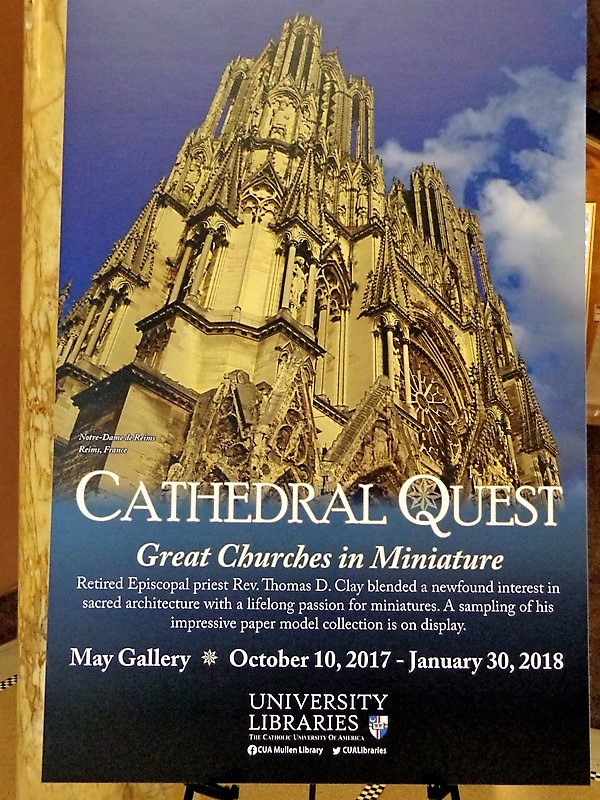
A Great Honor at Catholic University of America
https://mullenexhibits.wrlc.org/s/cathedrals/page/home